
Elevator Light Curtain: Safety Guide & How It Works
An elevator light curtain is a vital infrared safety device that creates an invisible barrier across elevator doors, instantly detecting passengers, luggage, or objects to prevent pinching accidents. This comprehensive guide explains how it works, installation best practices, troubleshooting common issues, and top brands—helping you ensure maximum safety and compliance while improving passenger experience. Read on for expert insights and actionable tips.
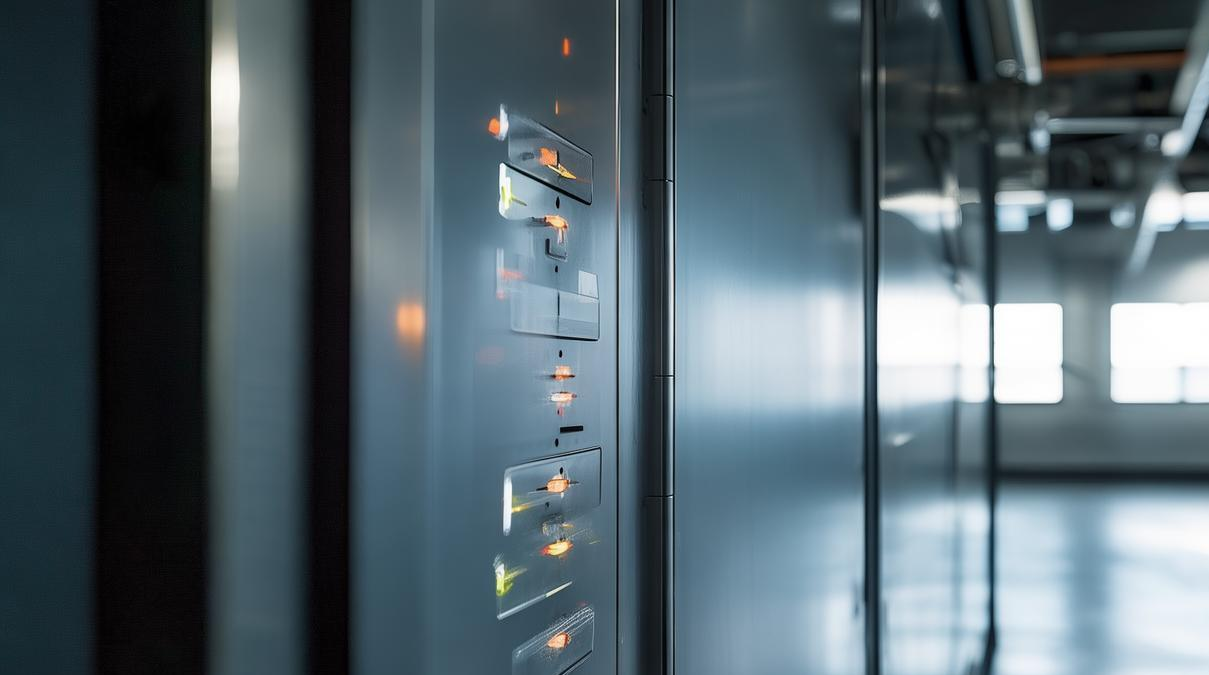
An elevator light curtain is an essential infrared safety device that projects an invisible grid of beams across elevator door openings, instantly detecting obstructions to prevent accidents. This non-contact anti-pinch protection system replaces traditional mechanical edges, offering faster response times and compliance with modern safety standards like EN 81-20 and ASME A17.1. Understanding how an elevator light curtain works—from emitter and receiver alignment to beam count and 2D versus 3D detection—is crucial for reliable operation. Proper installation, regular troubleshooting to avoid false alarms, and knowledge of leading brands such as Tri-Tronics, WECO, and CEDES help ensure passenger safety and reduce maintenance costs. This overview covers everything from working principles to best practices, providing a comprehensive resource for elevator professionals and building managers.
What Is an Elevator Light Curtain and How Does It Work?

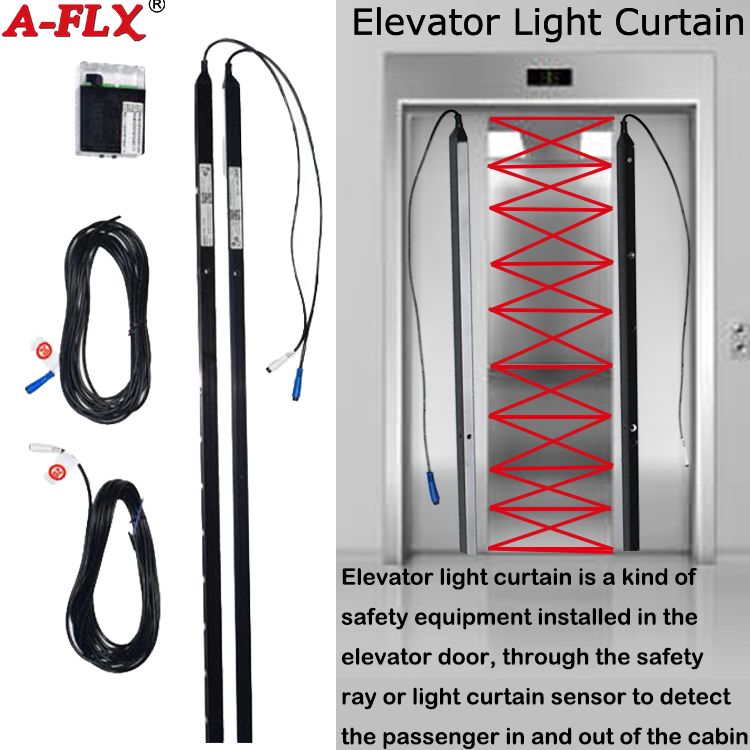
Core Definition and Purpose
An elevator light curtain is an infrared-based anti-pinch safety device. I install it on both sides of elevator doors. It projects a grid of infrared beams to form an invisible “safety barrier” across the door opening. When anything breaks a beam—a person, luggage, stroller, or pet—the system instantly tells the doors to stop and reverse. This is non-contact protection. Unlike mechanical safety edges, it has no moving parts and offers higher sensitivity. It is a key elevator safety sensor.
Working Principle: Emitter, Receiver, and Signal Feedback
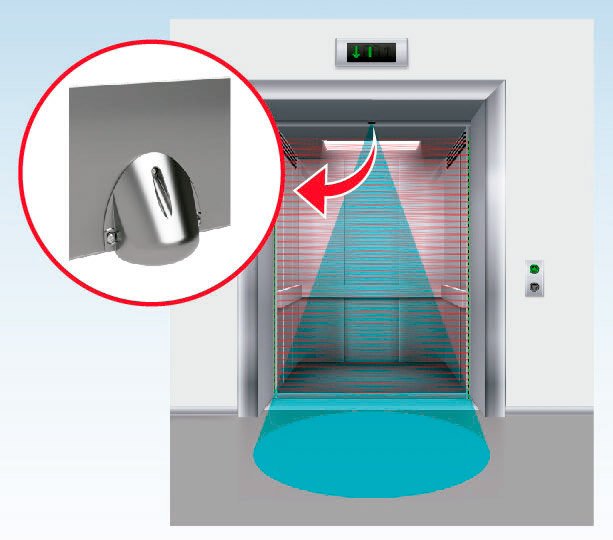
The system has two main parts: an emitter that sends infrared beams and a receiver that monitors them. The beams are scanned continuously. If a beam is blocked, a signal goes to the door operator within 10 to 20 milliseconds. ASME A17.1 requires a response time under 0.25 seconds. Most systems react in 0.1 to 0.3 seconds. Multiple LED and photodiode pairs detect object size, position, and speed. This makes the anti-pinch elevator sensor very reliable.
Beam Count, Coverage, and Detection Resolution
Beam counts range from 24 to 194 per opening. Typical units have 48 to 144 beams. Coverage starts 20 mm above the floor and goes up to about 2 meters. EN 81-20 demands beam spacing of 50 mm or less. With tight spacing, the curtain can detect objects as thin as 8 mm. I find 2D light curtains detect presence in a single plane. 3D light curtains add depth sensing for better passenger detection.
Safety Standards Compliance
EN 81-20 has required light curtains for all new elevators since 2017. ASME A17.1 and CSA B44 mandate annual functional tests. The nudging feature is also important. After a set time, doors close slowly with an audible alert. The light curtain stays active. If it detects an obstruction, it releases the doors to prevent injury. These standards make the elevator door protection system critical for passenger safety.
Thank you for sharing the precision and recall formulas as used in the SQuAD (Stanford Question Answering Dataset) evaluation. You’ve correctly stated the standard token-level definitions:
- Precision = tp / (tp + fp)
- Recall = tp / (tp + fn)
Where:
- tp (true positives) = number of tokens that appear in both the correct answer and the predicted answer.
- fp (false positives) = tokens in the prediction but not in the correct answer.
- fn (false negatives) = tokens in the correct answer but not in the prediction.
These metrics are commonly used in extractive QA tasks to measure how well a model's predicted answer spans overlap with the ground truth answer at the token level. The exact match (EM) and F1 score are then derived from precision and recall.
Would you like me to compute an example, explain how F1 is calculated from these, or discuss how SQuAD evaluation differs from other QA benchmarks? I’m happy to help.
Troubleshooting, Maintenance, and Common Failures

Common Signs of Failure
I often see sensor malfunction as the first clue. Doors stay open too long or close too long. They may not move at all or reverse without reason. You might hear unusual sounds from the door operator. Doors can get stuck or fail to respond to calls. Frequent false alarms are a big sign. The doors reverse when nothing is there. This happens due to dust, sunlight, or simple misalignment.
Root Causes of Malfunctions
Dust on the sensor windows is the top cause. It blocks the infrared beams. Environmental interference also plays a role. Direct sunlight, moisture, and big temperature swings can disrupt signals. Inside the unit, parts wear out. LEDs can burn out after about 50,000 hours of use. Photodiodes degrade over time. Software or programming issues may set the wrong beam count. Building vibration or loose brackets cause alignment drift. All these lead to elevator light curtain false alarms or complete failure.
Step‑by‑Step Troubleshooting Process
- Start with a visual inspection. Look for cracked photocells, loose brackets, and damaged cables.
- Clean the sensor surfaces every one to three months. Use a dry microfiber cloth or isopropyl alcohol.
- Use a laser alignment tool to check that the emitter and receiver are within 0.5° of perfect alignment.
- Perform a functional test. Block each beam manually with a test rod (10 mm diameter for 50 mm spacing). The door must reverse instantly.
- Measure the response time. It should be less than 0.25 seconds. Ideally, it is under 0.1 seconds.
- Check the environment. Remove reflective surfaces like mirrors or polished metal near the door opening.
- Document all test results per ASME A17.1 guidelines. Replace faulty units only with OEM‑approved parts.
Preventive Maintenance Checklist
Clean the lenses every one to three months. Inspect cables and connections every quarter. Test the full beam array annually with a test rod. Verify response time during the annual safety inspection. Use shields or shades to block strong sunlight interference. This routine keeps your elevator light curtain maintenance simple and effective. It also reduces elevator door safety device failures and costly repairs.
The formulas you provided for precision and recall are correct for evaluating token-level overlap in SQuAD (Stanford Question Answering Dataset) predictions. Here's how they apply:
-
Precision: Fraction of predicted tokens that are correct.
( \text{Precision} = \frac{TP}{TP + FP} )
(TP = tokens in both prediction and answer; FP = tokens in prediction but not in answer) -
Recall: Fraction of correct answer tokens that are found in the prediction.
(
Light curtains send infrared beams across elevator doors. When a beam breaks, the doors stop and open. I covered how to mount and align them. I also showed you how to fix dust and false alarms. You can pick from top brands like Tri-Tronics and CEDES. These safety devices save lives and meet code. They pay for themselves by cutting repair costs. Check yours now.References
-
https://www.pandaelevatorparts.com/what-is-an-elevator-light-curtain/
-
https://www.aflyelevators.com/how-does-an-elevator-light-curtain-work/
-
https://elevatorlightcurtains.com/elevator-light-curtain-installation-guide-safety-tips/
Connect
Get In Touch
With WECO Today
No.88 Hulin Road, Daqi, Beilun, Ningbo, 315806, China
TEL & WHATSAPP: 86 15857498114
Email: shadow@weco.cc